 Blackbird Archive
R.U.R.: “Inventing Roboti”
Karel Čapek and his brother Josef collaborated as writers on many projects, including The Insect Play , published in 1921. In addition to his brief but substantive contribution to R.U.R . as related below, he did the cover design for the 1920 edition, and multiple subsequent editions of R.U.R ; he is also cited in the 1920 edition as an editor.
For Rossum’s Universal Robots , Josef’s only credited contribution to the textual substance of R.U.R. was to suggest the word “robot” to describe the organic, but artificially made, workers. An account of this moment appears in a December 24, 1933 article “O Slove Robot” (“On the Robot Word”) in the Czech newspaper Lidové noviny .
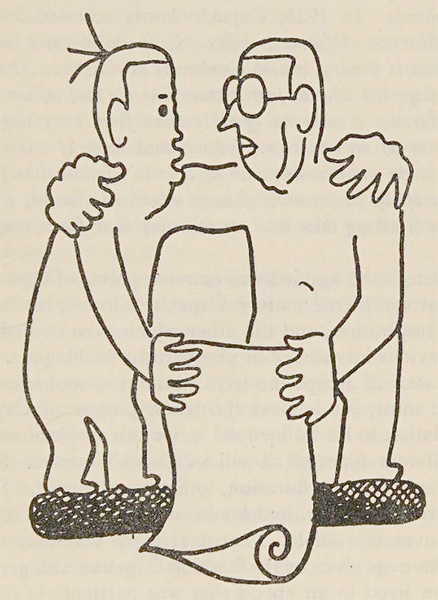
The author of the play RUR did not, in fact, invent that word, he merely ushered it into existence. It was like this: the idea for the play came to said author in a single, unexpected moment. And while it was still fresh he rushed immediately to his brother Josef, a painter, who was just standing by the easel, vigorously painting at a canvas.
“Listen, Josef,” the author began, “I think I have an idea for a play.”
“What kind of?” the painter mumbled (he really did mumble, because at the moment he was holding a brush in his mouth).
The author told him as concisely as he could.
“Then write it,” the painter said, without taking the brush from his mouth or stopping to work on the canvas. His indifference was quite insulting.
“But,” the author said, “I don’t know what to call those artificial workers. I could call them Laboři , but that strikes me as a bit literal.”
“Then call them Roboti ,” the painter muttered, brush in mouth, and carried on painting. So it happened . . .
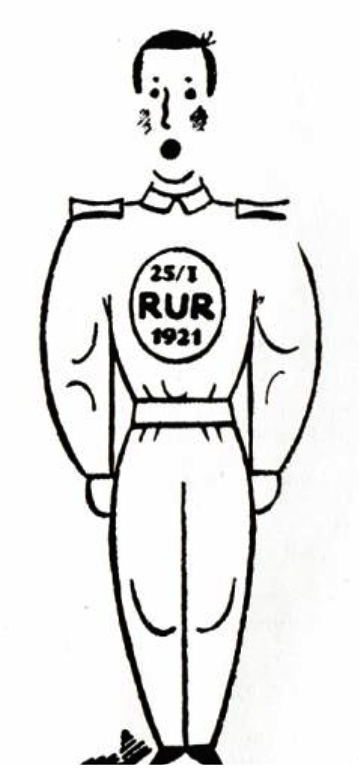

Josef Čapek (1887–1945) was a noted Czech painter, illustrator, writer, and book cover designer. He collaborated on many projects with his brother Karel Čapek and is credited by Karel with introducing to the world the word “robot” to describe an artificial laborer in the play R.U.R. Karel had been named by the Gestapo as “public enemy number two” before his death in 1938; so too Josef drew the attention of the Gestapo for his political stance and for caricatures published in Lidové noviny , a newspaper where he was, for eighteen years, an editor and critic. In September of 1939 he was arrested by the Gestapo and transferred first to Dachau, then to Buchenwald. There for two and half years, he was assigned to a calligraphic workshop where he painted family trees of SS officers. He was moved to Sachsenhausen in June of 1942 and there both translated and wrote poetry. His final move in February of 1945 was to Bergen-Belsen in the midst of a typhoid epidemic. He is said to have died shortly before the liberation of the camp, but his body—sought by his widow Jarmila Čapková who traveled to Bergen-Belsen after the war—was never located.